Change Management Examples and Actions
A practical reference guide for SQF Edition 10, Clause 2.3.5
Free download - no fluff, just the clarity you need to manage change without compromising food safety.
Why this matters
SQF Edition 10 places a stronger, more explicit expectation on how your business identifies, assesses, and controls change. Clause 2.3.5 requires you to manage change in a way that protects product safety, quality, legality, and integrity — every time, regardless of whether the change is planned, urgent, or forced on you by circumstance.
The problem? Most food businesses know they need to "manage change." Far fewer have a clear, practical framework that staff can actually follow when a supplier fails, a probe breaks, a recipe shifts, or a CCP deviation triggers a corrective action.
This guide closes that gap.
What's inside
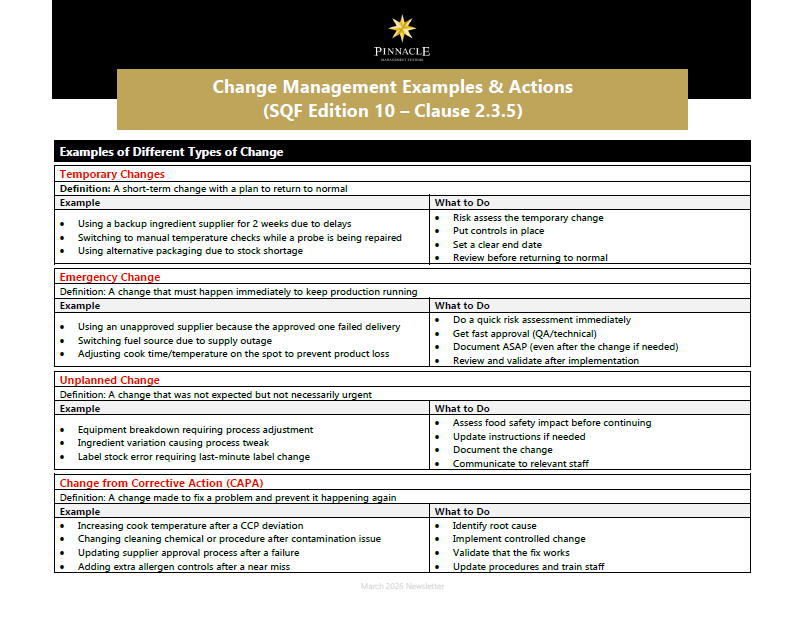
This two-page reference gives you a clear, at-a-glance framework covering:
The four types of change you'll encounter in your business
Temporary changes: short-term adjustments with a plan to return to normal
Emergency changes: immediate decisions to keep production running
Unplanned changes: unexpected but not urgent
Changes from Corrective Action (CAPA) : fixing problems so they don't recur
For each type, you get real-world examples and the specific actions required to keep your system compliant.
The four change categories mapped to food safety risks and required actions
Product formulations and manufacturing processes
Materials, ingredients, labels, inputs, and equipment
Specifications for raw materials, packaging, and chemicals
Food safety plan changes, including CCPs and critical limits
Each category links examples of change to the specific food safety risks they introduce and the required actions to manage them — so your team knows exactly what to do, and your auditor can see you're doing it.
Who this is for
This guide is designed for:
- SQF-certified sites preparing for the Edition 10 transition
- Food Safety and Quality Managers building or updating their change management procedures
- Production and operations leaders who need a practical reference when change happens on the floor
- Anyone responsible for demonstrating compliance with Clause 2.3.5 at audit
Lets Work Together
With audits expected from January 2027, now is the time to assess how your current system aligns with the new requirements, particularly around Food Safety Culture, Change Management, and Environmental Monitoring.
If you'd like a second set of eyes on your transition plan, or a structured gap assessment against Edition 10, we can help.
Save Time
Confidence
Compliance
Support